
8 receive / 1 transmit or 16 receive / 2 transmit radio-channel configurations
Y501-L Indoor LoRaWAN Gateway, 8 or 16 Channels
LoRaWAN Indoor Gateway
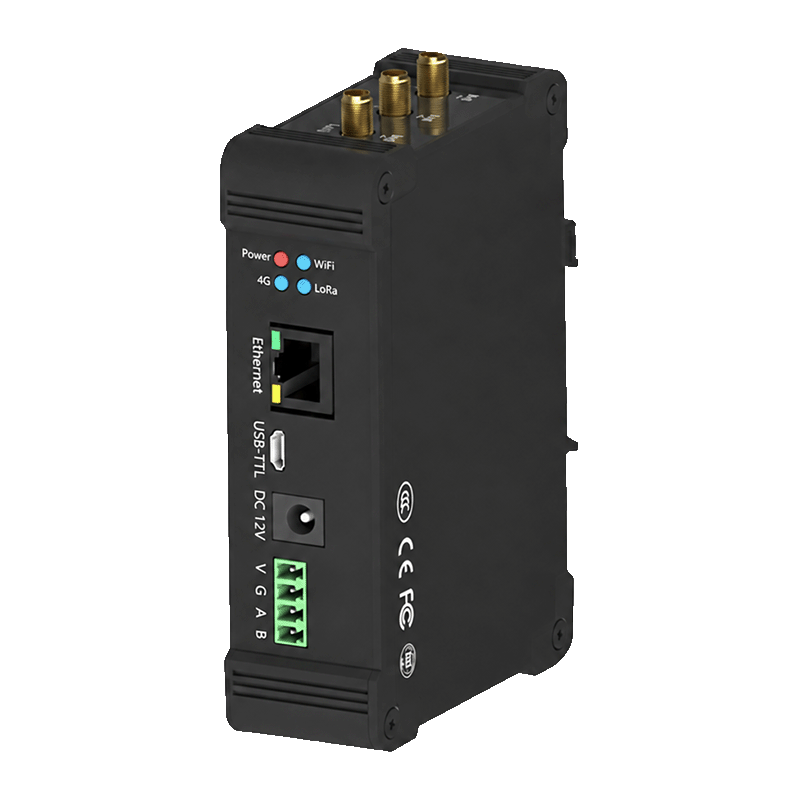
Y501-L forwards LoRaWAN device traffic to a Network Server through Ethernet or Wi-Fi. Choose 8 or 16 channels, with optional 4G backhaul and local NS/AS software.
Key Features
Supports LoRaWAN 1.0.2, 1.0.3 and 1.0.4 Class A and Class C end devices
10/100 Mbps Ethernet and 2.4 GHz Wi-Fi backhaul, with 4G available as an order option
UDP/GWMP or MQTT packet forwarding to a compatible Network Server, according to deployment mode
Local Network Server / Application Server and RS485 Modbus data access require the corresponding software option
Local Web configuration and firmware upgrades, with remote management where enabled
Specifications
LoRaWAN Radio
- Supported End Device Versions
- LoRaWAN 1.0.2 / 1.0.3 / 1.0.4
- Supported End Device Classes
- Class A / Class C
- Frequency Plans
- CN470 (default), EU433, EU868, AU915, IN865, AS923, RU864, US915; region-specific hardware; specify the AS923 sub-plan when ordering
- Channel Options
- 8 RX / 1 TX or 16 RX / 2 TX
- Duplex
- Half-duplex or full-duplex hardware options
- Transmit Power
- Up to 27 dBm; use settings allowed by the regional plan
- Receiver Sensitivity
- Down to -140 dBm at SF12, BW125 kHz
- Spreading Factor
- SF7–SF12
- Capacity
- Device capacity depends on payload size, reporting interval, airtime, interference and regional radio limits. Channel count alone does not determine capacity.
Network Interfaces
- Ethernet
- 10/100 Mbps RJ45
- Wi-Fi
- 2.4 GHz; AP, STA or AP+STA, depending on the Wi-Fi variant
- Cellular
- Optional 4G; supported operator bands depend on the cellular module
- RS485
- Standard A/B hardware; Modbus RTU data access requires compatible local-service software
- USB
- MicroUSB USB-TTL debug/log interface
Network Services
- Packet Forwarding
- UDP/GWMP or MQTT, depending on deployment mode and the Network Server’s supported interface
- Local Services
- Local Network Server / Application Server (NS/AS), available as a software option
- Modbus Integration
- RS485 Modbus access requires the local-service software option and a matching register map, function codes, byte order and scaling. Packet-forwarding firmware alone does not poll instruments.
Power Supply
- Voltage
- DC 9–28 V; typical DC 12 V
- Maximum Current 8 Channel
- 850 mA at DC 12 V
- Maximum Current 16 Channel
- 1.5 A at DC 12 V
- Average Power 8 Channel
- ≤3 W
- Average Power 16 Channel
- ≤7 W
- Maximum Power 8 Channel
- 10.2 W at DC 12 V
- Maximum Power 16 Channel
- 18 W
Environmental
- Operating Temperature
- -20 to 70 °C
- Storage Temperature
- -40 to 85 °C
- Humidity
- 0–95% RH, non-condensing
- Location
- Indoor
Mechanical
- Dimensions 8 Channel
- 120.4 × 79.7 × 34 mm
- Dimensions 16 Channel
- 125.5 × 120.4 × 34 mm
- Weight 8 Channel
- Approximately 1 kg
- Weight 16 Channel
- Approximately 1.5 kg
- Mounting
- DIN rail or wall mounting with the matching bracket
Deployment
- Regional Matching
- Match gateway, Network Server, and end-device plans and channel groups, including AS923 sub-plan
- Downlinks
- Class A receives downlinks after an uplink. Class C provides more receive opportunities. Delivery time depends on airtime, server scheduling and regional radio limits.
- Ordering
- Specify channel count, duplex mode, antennas, backhaul and software options with your order
Product Documents
Related Products

Talk to our technical team.
Tell us about your interfaces, network environment, and deployment requirements.