
Voltage
Read the number in volts (V). It must fall inside the equipment’s input range.
Frequency
Read the number in hertz (Hz). Motors, timers and some power supplies care about it.
Plug and socket
Check the physical shape, earthing and current rating. A fitting plug does not prove voltage compatibility.
If it fits, it can still be wrong. Treat electrical compatibility and mechanical fit as two separate checks.
Countries built their low-voltage networks at different times, so the same piece of equipment may meet a 100 V, 120 V, 220 V or 230 V supply. Plug shapes also vary. This guide gives a fast planning view for common markets; it is not a substitute for the local wiring code or a site measurement.
Start with the equipment nameplate
The small label on a power supply or machine answers the first question. Look for the input voltage, frequency, maximum power and number of phases before you choose a cable or adapter.
| Nameplate example | What it usually means | Next action |
|---|---|---|
| 100–240 V~ 50/60 Hz | Wide-range input for both common voltage families. | Choose the correct plug, then check earthing and current. |
| 220–240 V~ 50 Hz | Designed for the higher-voltage, 50 Hz family. | Do not connect directly to a 100–127 V supply. |
| 120 V~ 60 Hz | Designed for the North American-style supply. | Do not rely on a plug adapter when the site is 230 V. |
| Input: 3-phase 400 V | Not a normal single-phase wall-outlet load. | Use the project electrical design and a qualified installer. |
Recognize the common plug families
The letters below are a convenient visual shorthand used in international guides. They do not replace national standard numbers such as BS 1363, NEMA, AS/NZS 3112 or GB standards. The diagrams are illustrative front views, not manufacturing drawings.
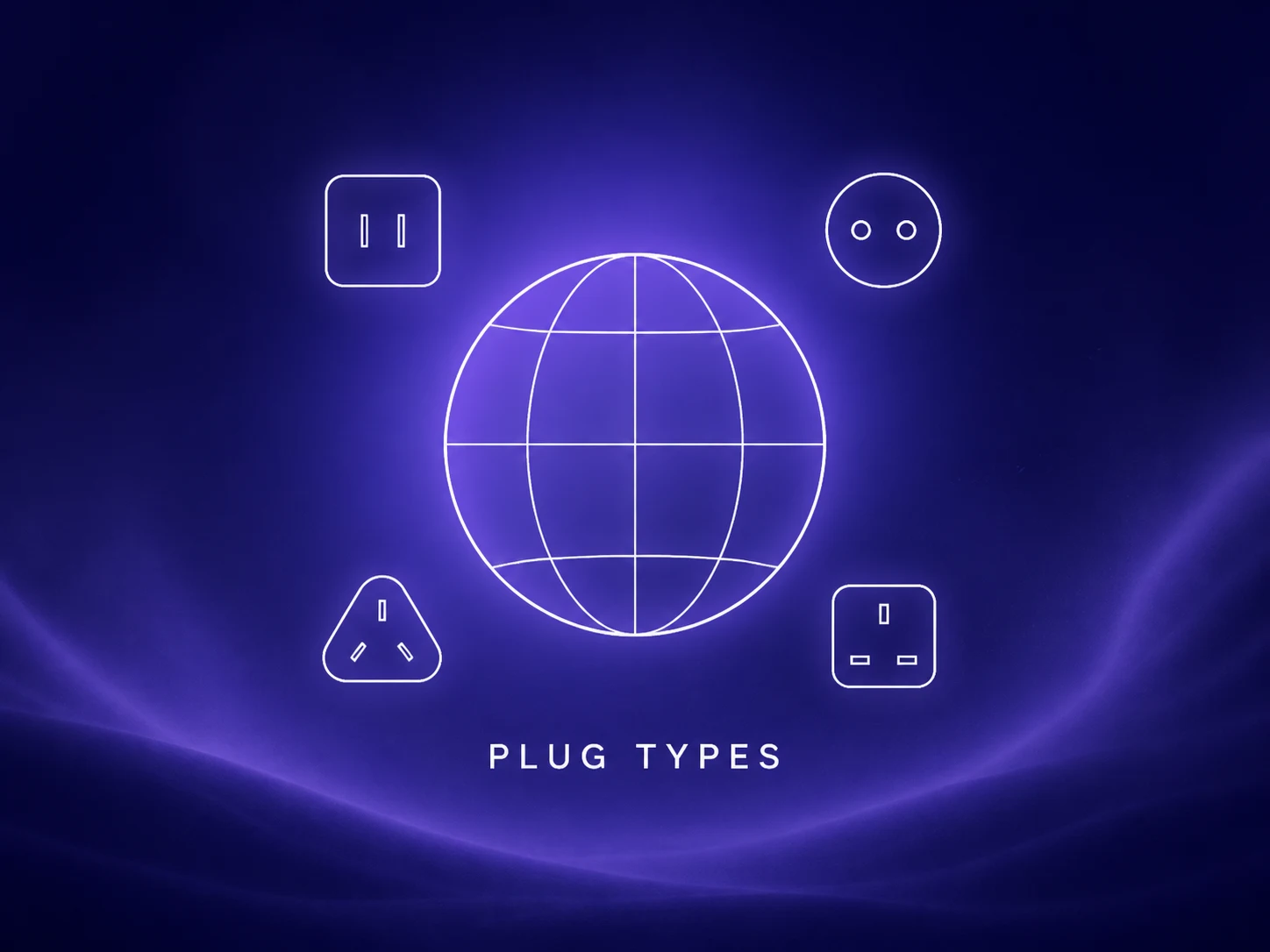
- A/B: flat parallel pins, common in the United States, Canada, Mexico and Japan.
- C/E/F: round-pin systems used across continental Europe, with different earthing arrangements.
- G: three rectangular pins, used in the United Kingdom and several former British-standard markets.
- I: angled flat pins, common in Australia, New Zealand, mainland China and Argentina.
- D/M, J, L and N: grounded round-pin families used in parts of South Asia, Europe, Africa and South America.
Country and regional quick guide
Use this table to create a first-pass country list. Values describe common single-phase low-voltage supply. Local distribution, older buildings, hotels, industrial parks and backup generators can use different circuits or more than one socket style.
The country values below describe AC mains, not a device’s low-voltage DC input. Equipment labeled for DC power must not be connected directly to mains. Use an appropriately rated, approved power supply and check its output voltage, polarity and current capacity.
| Region | Market | Typical supply | Common plug type(s) | Quick note |
|---|---|---|---|---|
| North America | United States | 120 V · 60 Hz | A, B | Residential service can also include 240 V circuits; ordinary receptacle planning is usually 120 V. |
| North America | Canada | 120 V · 60 Hz | A, B | Industrial sites may use 120/208/240 V arrangements. Confirm the connection point. |
| North America | Mexico | 127 V · 60 Hz | A, B | Do not reduce the national nominal value to “110 V” when checking a nameplate. |
| Europe | Continental Europe (typical) | 230 V · 50 Hz | C, E, F | The EU has no single household plug law; French/Belgian and Schuko systems differ in earthing. |
| Europe | United Kingdom, Ireland, Malta, Cyprus | 230 V · 50 Hz | G | British BS 1363 uses rectangular pins and a fused plug. |
| Europe | Switzerland, Liechtenstein | 230 V · 50 Hz | J | The Swiss system looks close to IEC 60906-1 but is not identical. |
| Europe | Italy | 230 V · 50 Hz | L (also C) | Check the socket current rating and earthing form for the actual installation. |
| Asia | Mainland China | 220 V · 50 Hz | A, C, I | Some wall sockets accept several shapes, but the supply remains 220 V. |
| Asia | Japan | 100 V · 50/60 Hz | A, B | Eastern Japan uses 50 Hz and western Japan 60 Hz; motors need a frequency check. |
| Asia | South Korea | 220 V · 60 Hz | C, F | Two round-pin sockets are common; verify the equipment frequency range. |
| Asia | India | 230 V · 50 Hz | C, D, M | Large round-pin D/M systems are not the same as a low-current Europlug. |
| Asia | Singapore | 230 V · 50 Hz | G | Fixed installation and modifications require a licensed electrical worker. |
| Asia | Malaysia | 240 V · 50 Hz | G | Project documents may state 230 V or 240 V; use the local connection data. |
| Oceania | Australia, New Zealand | 230 V · 50 Hz | I | Older equipment may still carry a 240 V label; the plug family remains a separate check. |
| Middle East | United Arab Emirates | 230 V · 50 Hz | G | Abu Dhabi DoE regulations specify 230 V single-phase and nominal 50 Hz at the connection point. |
| Africa | South Africa | 220–230 V · 50 Hz | D, M, N | National and project documents can use different nominal wording; verify the site. |
| Latin America | Brazil | 127 V or 220 V · 60 Hz | N (also A/C in some equipment) | Voltage varies with region and distribution system, so the country name is not enough. |
| Latin America | Argentina | 220 V · 50 Hz | I (also C) | The angled-pin family resembles Australia/New Zealand, but socket versions still vary. |
Choose the right kind of power accessory
Adapter
Use when the equipment already supports the site voltage and frequency. It changes the plug shape only.
Transformer
Use for a voltage mismatch only after checking load power, inrush current, heat, protection and earthing.
Frequency converter
Use only with an engineering design. Motors, pumps, clocks and some chargers can behave differently at 50 or 60 Hz.
Four checks before power-on
- Read the nameplate. Record voltage range, frequency, maximum power, current and phase.
- Confirm the connection point. Use local utility data and project drawings; have a qualified electrician verify the actual supply when needed.
- Separate fit from safety. Select the national plug/socket, earthing, fuse or breaker and current rating as separate decisions.
- Have fixed work inspected. A distribution board, hard-wired converter, industrial socket or outdoor cabinet belongs in the local electrical design.
International references
- IEC TR 60083:2015 — national plug and socket systems.
- IEC 60038 — standard voltage values.
- European Commission REFIT opinion — no single EU household plug law and the C/E/F/G split.
Country references
- U.S. Department of Energy — 110–120 V, 60 Hz context.
- UK Electricity Supply Regulations 2002 — 230 V, 50 Hz.
- NSW Government voltage guide — Australia 230 V recommendation and legacy 240 V labels.
- New Zealand WorkSafe — 230 V, 50 Hz and AS/NZS 3112.
- China NDRC supply rules — 220 V, 50 Hz.
- Japan METI electricity FAQ — eastern 50 Hz and western 60 Hz.
- Bureau of Indian Standards — 230 V, 50 Hz and Type D.
- Abu Dhabi Department of Energy — 230 V, 50 Hz.
- Brazil ANEEL distribution procedures — 127/220 V nominal systems.
- Mexico Official Gazette — 127 V, 60 Hz.